



Articles
What Is Knurling? Why Premium Steel and Aluminium Handles Cost More
Pick up a well-made barbell, cable attachment or lifting handle and one detail immediately separates it from cheaper equipment: the grip feels deliberate.
It does not slide in the hand or depend on a soft sleeve that can twist, split or perish. Instead, the metal itself carries an accurately repeated pattern of peaks and grooves. That pattern is knurling.
Knurling is sometimes described as little more than adding texture to metal. That understates the engineering involved. Producing a clean and consistent knurl on steel or aluminium requires specialist machinery, hardened tooling, controlled pressure, accurate alignment and an understanding of how the chosen material will behave.
Done properly, it improves grip, control and durability. It also creates the unmistakable finish associated with precision tools, professional barbells and premium strength equipment.
What is knurling?
Knurling is a manufacturing process that produces a regular pattern of straight, diagonal or intersecting grooves on a component, most commonly on a cylindrical surface. The familiar diamond pattern found on barbells and metal lifting handles is formed from two opposing diagonal patterns.
As the hand closes around the finished surface, the raised features create additional contact points and resist movement in more than one direction. The result is greater mechanical grip without attaching a separate rubber or foam covering.
Knurling is used on tool handles, control knobs, precision instruments, fasteners and industrial components as well as strength equipment. It can also help a metal insert resist rotation inside a softer material. In gym equipment, however, its principal purpose is simple: to produce a secure, repeatable and long-lasting gripping surface.
A proper knurl is not a coating or a decorative sleeve. It is functional geometry machined into the component itself.

How are steel and aluminium bars knurled?
The workpiece is normally held and rotated in a lathe or CNC turning centre. A specialist tool carrying one or more hardened, toothed wheels is brought into carefully controlled contact with the rotating bar.
The tool must be set at the correct centre height and presented squarely to the work. Speed, feed, pressure, lubrication, starting diameter and support all affect the finished result. Incorrect setup can produce a shallow pattern, torn material or the unmistakable overlapping pattern known as double tracking.
Form knurling: moving the metal
Form knurling creates the pattern through controlled plastic deformation. The hardened wheels press into the rotating component, forcing metal down into the valleys and displacing it upwards to form the peaks. It is a cold-forming operation rather than a conventional material-removal process.
It creates no cutting swarf, can generate strong features and may slightly work-harden the immediate surface. It can also place considerable radial load on the tool, spindle and component. Long or slender bars require effective support, while the increase in finished outside diameter must be allowed for during design.
Cut knurling: removing the metal
Cut knurling progressively machines the grooves into the workpiece. It normally applies less forming pressure, causes little change to the component's outside diameter and can produce an exceptionally crisp visible finish. It is useful for thin-walled, deformation-sensitive or particularly hard components.
The process creates swarf and demands accurate tool alignment, cutting geometry and process control. Specialist tooling and additional setup contribute to its cost.
Form knurling versus cut knurling
| Consideration | Form knurling | Cut knurling |
|---|---|---|
| Action | Displaces material | Removes material |
| Machine load | Higher radial force | Generally lower force |
| Diameter | Usually increases | Minimal change |
| Waste | No cutting swarf | Produces swarf |
| Typical strength | Efficient repeat forming | Precision and surface quality |
Steel and aluminium do not behave in the same way
Knurling steel
Steel requires robust tooling, rigid machine setup and greater forming force than most aluminium alloys. Tool wear, lubrication and spindle load must all be considered.
Stainless steel can be especially demanding because it is tough and prone to work-hardening. If the tool rubs rather than cutting or forming correctly, heat and surface hardening can make the operation progressively more difficult. When properly executed, however, the result is an exceptionally durable gripping surface that cannot rotate like a sleeve or peel away like a coating.
Knurling aluminium
Aluminium is softer and usually requires less force, but that does not make a high-quality result automatic. The material can yield too readily, causing teeth to fold or tear instead of forming cleanly. Softer aluminium can also adhere to and clog the knurling wheels.
The machinist must match the pattern, pitch and depth to the alloy, control feed and pressure, and use appropriate lubrication. A good aluminium knurl provides useful grip while avoiding fragile points that flatten prematurely.
Steel resists the tool. Aluminium yields more readily. Both need the correct tooling and machining parameters to remain sharp, uniform and concentric.
Why does quality knurling add to the price?
A knurled grip may occupy only part of a product, but it introduces multiple manufacturing costs.
Specialist tooling
Knurling wheels are precision tools manufactured from hardened tool steel or carbide. Different patterns, pitches, angles, diameters and materials can require different wheels and holders. These are costly consumable tools: as the edges wear, pattern definition deteriorates.
Additional machine time
The component must be loaded, aligned, supported and machined at a controlled speed and feed. Machine time is one of the largest costs in precision manufacturing. Even a short extra operation becomes significant across a production run.
Preparation and finishing
The workpiece may first need to be turned to a calculated starting diameter. The edges of the pattern may then require chamfering or cleaning so the grip feels engineered rather than unfinished. Any later plating or coating must be considered because it can soften or fill a fine pattern.
Inspection and rejected parts
A defective knurl is difficult to disguise. Poor alignment can cause double tracking; too much pressure can distort the component; too little engagement leaves incomplete teeth. If that happens late in the manufacture of a stainless-steel handle, the whole component may be rejected.
Smaller production quantities
Specialist strength equipment is manufactured in far lower quantities than mass-market rubber-handled attachments. Programming, setting, tooling and inspection costs are therefore distributed across fewer products.
Premium finish is not appearance alone. Proper knurling costs more because it requires more tooling, more machine time, tighter control and closer inspection.
The anatomy of a quality knurl
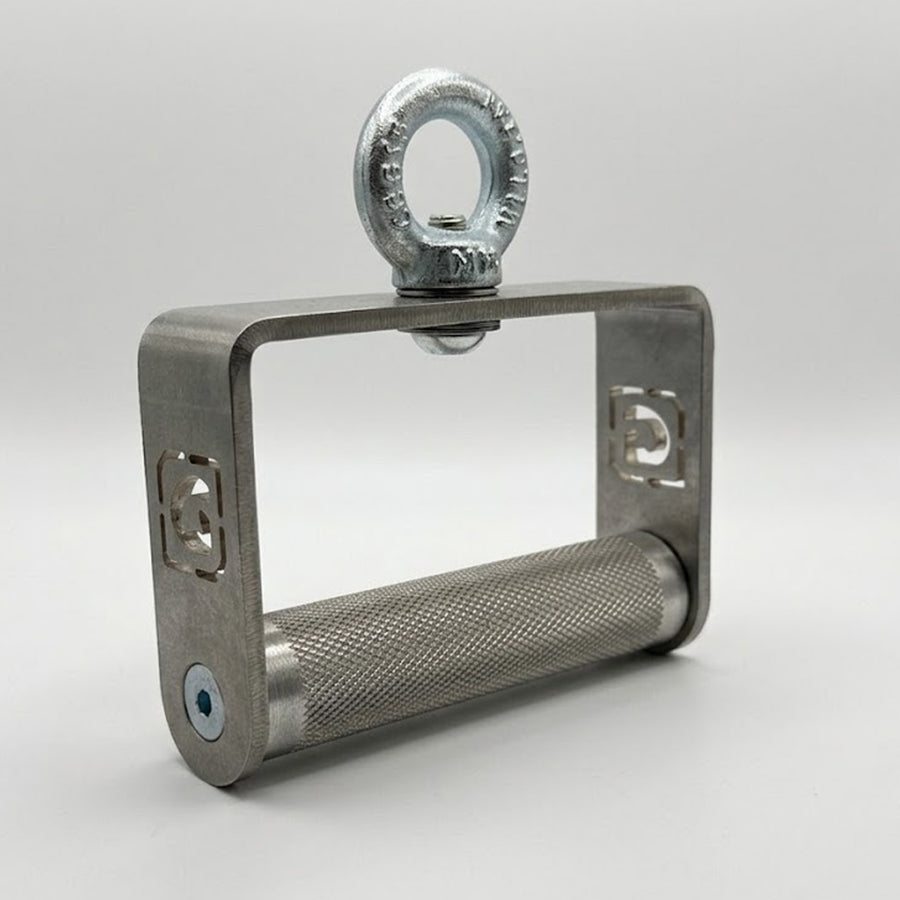
Not all knurling is equally good. A high-quality grip should show:
- Consistent pitch across the complete gripping area
- Fully formed and evenly repeated diamonds or ridges
- No visible double tracking
- Clean boundaries at both ends
- Concentric machining around the handle
- A depth appropriate to its intended use
- No loose material or dangerously sharp burrs
- No flattened, torn or incomplete sections
The correct aggressiveness also depends on the application. A powerlifting bar intended for a maximal deadlift may use a sharper pattern than a cable handle designed for repeated sets, multiple hand positions and lifting straps.
More aggressive is not automatically better. The best knurl is the one that provides the required security without unnecessarily damaging hands, straps or the training experience.
Knurl patterns, pitch and engineering specifications
| Pattern | Description | Typical purpose |
|---|---|---|
| Straight | Parallel grooves | Directional grip, knobs and mechanical engagement |
| Diagonal | Left- or right-hand helix | Directional control and specialist applications |
| Diamond | Intersecting left- and right-hand grooves | Multidirectional hand grip |
Pitch is the spacing between repeating elements. A finer pitch creates smaller, closely spaced teeth; a coarser pitch creates larger features. Pitch alone does not define aggressiveness. Tooth height, tip shape, pattern angle, base material and any coating also affect how a grip feels.
A complete manufacturing drawing may specify the pattern, pitch, helix angle, starting and finished diameters, knurled length, location, permitted runout, manufacturing method, edge treatment and final surface finish.

International knurling standards
Knurling follows recognised engineering conventions, but there is no single worldwide scale that grades a gym handle as “passive”, “medium” or “aggressive”. Those descriptions remain partly application- and manufacturer-specific.
ISO 13444
ISO 13444:2012 covers the dimensioning and indication of straight and diamond knurling on cylindrical surfaces. It restricts certain geometries and pitches to encourage uniformity, reduce defective work and avoid an unnecessary proliferation of tools.
DIN 82
DIN 82 is widely used to identify established knurl forms. Common designations include RAA for axially parallel grooves, RBL and RBR for left- and right-hand patterns, and RGE for a raised-point diamond pattern. The standard gives designers and machinists an agreed vocabulary rather than leaving a drawing to say only “add grip”.
ANSI/ASME B94.6
In North American engineering, ANSI/ASME B94.6 established standard relationships for knurls, tools and diametral pitches. These standards make geometry repeatable; they do not remove the need to select a pattern suitable for the user and application.
Specification matters: “Knurled” is not a complete manufacturing instruction. Pattern, pitch, dimensions and location determine whether the result is functional, repeatable and comfortable.
Benefits of knurled gym equipment
- Reliable grip: raised geometry helps resist unwanted movement, particularly as loads rise or hands become warm.
- Better control: less attention is spent readjusting the hand, allowing greater focus on the exercise.
- Consistency: metal does not compress or rotate like a loose soft grip.
- Strap compatibility: an appropriately selected knurl gives lifting straps a stable surface to engage with.
- Long service life: the texture is part of the component rather than an adhered layer that can peel away.
- Premium appearance: a precise pattern exposes the quality of the machining and gives the product the visual language of professional tools.
Are there disadvantages?
- Higher tooling and manufacturing cost
- Possible discomfort if the pattern is too sharp for the application
- More involved cleaning than a completely smooth surface
- Faster lifting-strap wear if the teeth are unnecessarily aggressive
- Potential corrosion where an unsuitable coating wears from carbon-steel peaks
- Scrapped components when the machining operation goes wrong
These are reasons to specify knurling intelligently, not reasons to avoid it.

Knurling across the GymPin range
GymPin uses knurled features where a secure, durable contact surface contributes directly to a product's function.
The G Handles — Stainless Steel
The stainless-steel G Handles feature comfortable, secure metal knurling. The aim is to balance grip and repeated use while allowing the handle to integrate effectively with wrist straps. It is a functional finish, not an attempt to make the sharpest handle possible.
Fixed D Handle
The Fixed D Handle is offered with rolling or fixed knurled-handle configurations. Its extra-wide format accommodates larger hands, while the metal grip creates a consistent contact surface. The rolling version allows the handle to rotate smoothly under load without relying on a loose rubber sleeve.
GymPin Safety Squat Handles
The Safety Squat Handles use a defined metal knurl for confident hand placement. Each handle is approximately 450mm long and 32mm in diameter, giving the athlete substantial gripping space and leverage while helping maintain upper-body position.
GymPin Hyper Loader
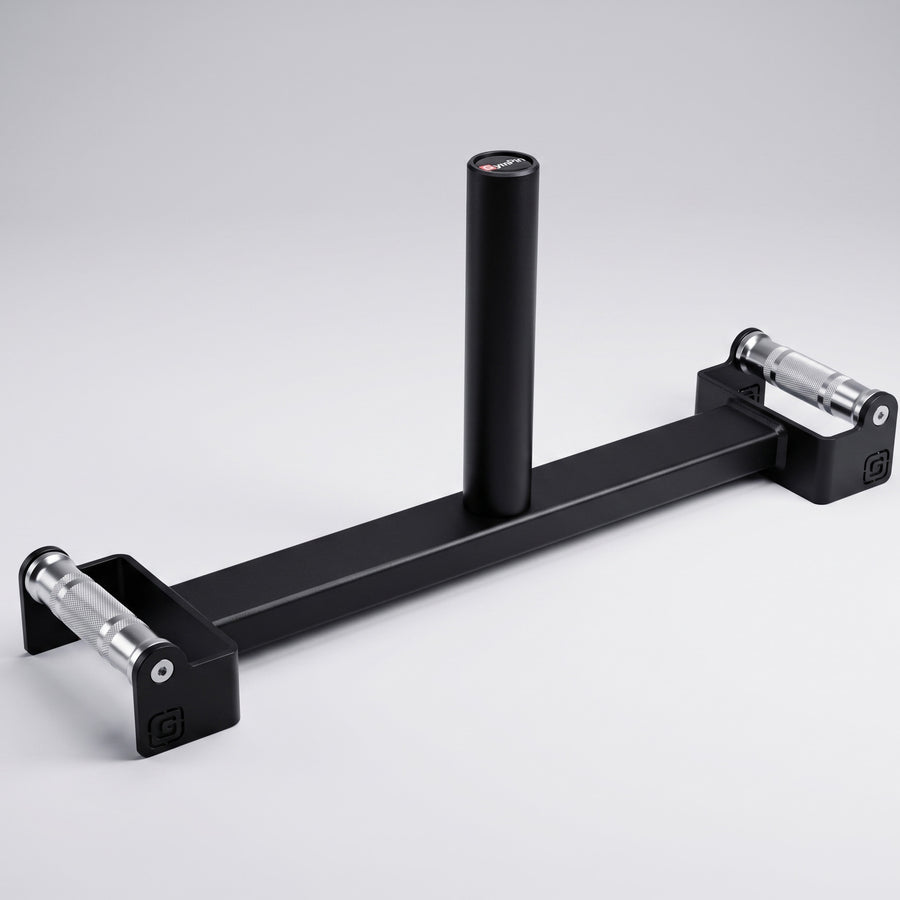
The Hyper Loader incorporates knurled steel handles into its heavy-duty frame. During weighted hyperextensions, the secure contact surface supports both the training movement and confident loading, carrying and positioning of the equipment.
Fabric D Handles
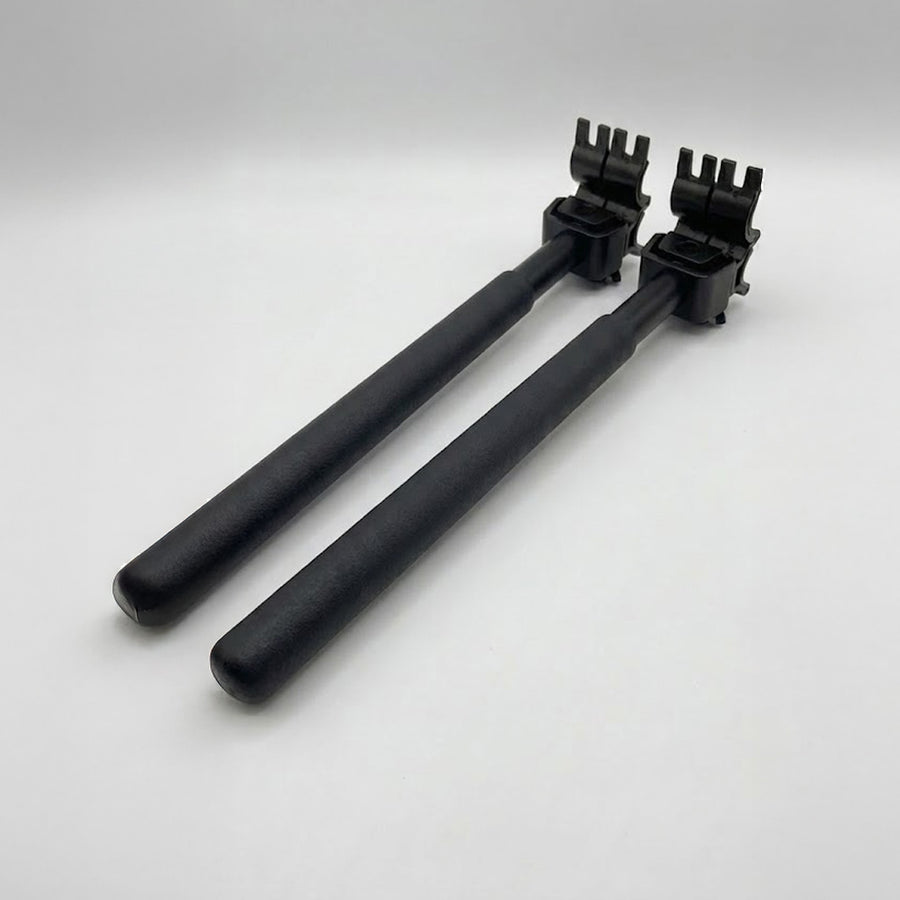
GymPin's Fabric D Handles use a rubber-knurled grip rather than a lathe-machined bare-metal surface. The principle is similar—engineered texture to resist unwanted movement—but the rubber produces a warmer and less aggressive interface suited to high-repetition cable work.
Heavy-Duty Smash Burger Press
Knurling is not confined to the gym. The stainless-steel GymPin Burger Patty Press includes a knurled metal handle for improved control as pressure is applied to its five-inch pressing face. The pattern remains secure around moisture and cooking oils while giving the press a professional, tool-like finish.
Engineered grip. Built into the product.
Explore GymPin handles and attachments designed for control, durability and serious training.
Frequently asked questions
What is the main purpose of knurling?
On gym equipment, the main purpose is to increase grip and control by machining or forming a repeatable pattern into the handle. In wider engineering, knurling can also assist press fits, resist rotation or provide a decorative finish.
Is knurling cut into the metal?
It can be. Cut knurling removes material to create the pattern. Form knurling instead displaces the surface under pressure, forcing metal into peaks and valleys without conventional cutting.
Can both steel and aluminium be knurled?
Yes. Steel generally demands greater force and rigid tooling, while aluminium forms more readily but can tear, fold or adhere to the tool if the process is poorly controlled.
Why are knurled handles more expensive?
They require specialist hardened tooling, an additional lathe or CNC operation, skilled setup, controlled machining and inspection. Worn tools or machining errors can also cause expensive rejected components.
Does a sharper knurl always provide a better grip?
No. The correct aggressiveness depends on the exercise, expected load, repetition range and whether lifting straps will be used. A pattern can be secure without being unnecessarily abrasive.
Does knurling wear out?
A quality metal knurl is highly durable because it is part of the handle itself. It can gradually become smoother through extensive use or suffer damage and corrosion, but it cannot rotate, peel or split like a separate sleeve.
Why this manufacturing detail matters
Knurling sits at the point where functional engineering meets visual craftsmanship. Its benefit is immediately felt, but the decisions behind it are largely invisible: material behaviour, starting diameter, tool geometry, pitch, pressure, feed rate, alignment and finishing.
That is why properly knurled metal is frequently found on premium equipment. It costs more because it requires more—more tooling, more machine time, tighter process control and closer inspection.
The result is not simply a more expensive texture. It is a gripping surface engineered into the product rather than added afterwards.
The best manufacturing details improve how a product looks, feels and performs—every time it is used.