


GymPin Learning Centre
Build a Bigger Chest
An evidence-led guide to chest anatomy, exercise selection, progressive overload, shoulder-friendly technique and equipment that solves genuine training limitations.

The practical answer
How do you build a bigger chest?
Build the pectoralis major by combining stable pressing with movements that train horizontal adduction, using flat and modest incline angles to cover different fibre directions. Perform enough challenging weekly sets, work close enough to failure for the sets to matter, and progress the demand without sacrificing range or control. Support the programme with adequate protein, calories, sleep and balanced shoulder training.
Diagnose the problem
Why your chest may not be growing
Chest growth rarely stalls because one secret exercise is missing. The usual causes are inadequate progression, poorly targeted movement, insufficient challenging volume or a recovery plan held together by optimism.
No measurable progression
The exercise selection may be adequate, but the training demand has not increased. Track working sets, repetitions, load and execution.
Pressing becomes a shoulder exercise
An unsuitable bench angle, unstable setup or elbow path can shift more work towards the anterior deltoid. Adjust the movement rather than forcing one universal technique.
Only one movement pattern
Presses are valuable, but the pectoralis major also produces horizontal adduction. Cable and fly variations can train that function directly.
Too little challenging volume
A few comfortable sets once a week may not provide enough stimulus. Build a repeatable weekly dose and distribute it across sessions when useful.
Every set is either easy or catastrophic
Sets need to be challenging, but absolute failure is not mandatory. Most work can finish close to failure while preserving technique and subsequent performance.
Recovery cannot support the plan
Sleep, protein, total calories and spacing between hard sessions determine whether useful training becomes adaptation or merely an elaborate fatigue collection scheme.
Anatomy made useful
The anatomy behind a fuller chest
The visible chest is dominated by the pectoralis major. Its fibres run in different directions, so exercise angle can bias regions, but no press or fly completely isolates an imaginary separate upper or lower chest muscle.
Pectoralis major: clavicular fibres
Fibres originating near the clavicle contribute strongly to shoulder flexion and horizontal adduction. Modest incline pressing and low-to-high cable paths can bias their line of pull.
Practical pointUse an incline that still lets the chest remain the target. Excessive incline increasingly resembles shoulder pressing.Pectoralis major: sternocostal fibres
The larger central and lower portion contributes to horizontal adduction and extension of the flexed arm. Flat pressing, converging presses and mid-height flyes train it effectively.
Practical pointA stable setup and controlled depth often matter more than chasing a supposedly perfect exercise.Abdominal fibres
The lower fibre region assists adduction and drawing the arm down from a raised position. Dips and high-to-low cable work may bias this direction when performed comfortably.
Practical pointBias is not isolation. The pectoralis major works as an integrated muscle across pressing and adduction tasks.Pectoralis minor
This smaller muscle lies beneath the pectoralis major and acts on the scapula. It is not the visible chest mass most lifters are trying to enlarge.
Practical pointDo not confuse sensation near the front of the shoulder with superior chest stimulus.Serratus anterior
The serratus protracts and upwardly rotates the scapula. Push-up variations with active reach can train it while supporting healthy scapular movement.
Practical pointThe shoulder blade does not need to be permanently pinned in every chest exercise.Supporting muscles
The anterior deltoids and triceps assist pressing, while the rotator cuff and upper back help control the shoulder and stabilise the setup.
Practical pointA bigger press is useful only when the chest remains meaningfully loaded and the joints tolerate the movement.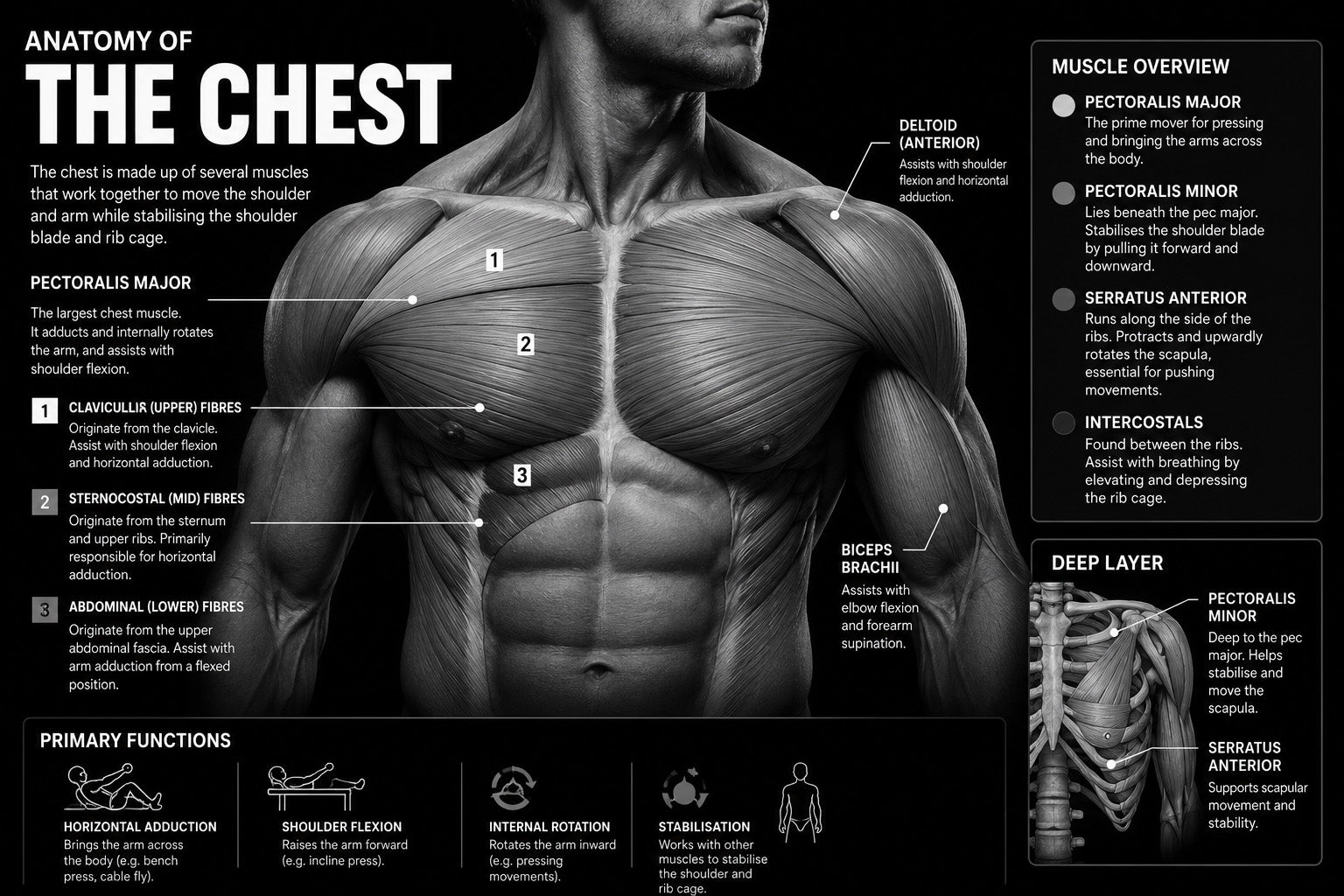
What the evidence supports
The principles that actually drive chest growth
Exercise choice matters, but it works inside a larger system: sufficient effort, recoverable volume, progressive overload, useful range of motion and consistent recovery.
Mechanical tensionChoose stable exercises that let the chest produce high force through a useful range of motion.
Proximity to failureMost hypertrophy sets should become genuinely challenging. Training to absolute failure is optional, not a ritual requirement.
Weekly volumeBegin with a recoverable number of hard sets and add volume only when performance, soreness and recovery support it.
FrequencyTraining chest twice weekly often makes it easier to distribute quality work than compressing everything into one heroic Monday.
Range and muscle lengthUse controlled depth and exercises that load the chest in a lengthened position when comfortable. Current evidence is promising, but it does not justify reckless stretching under load.
ProgressionProgress load, repetitions, sets, range, control or stability. More weight is one tool, not the entire definition.
Exercise library
Exercises that build a bigger chest
No single movement owns chest development. Select a small group of presses and adduction movements that feel stable, tolerate progression and cover the fibre directions you want to emphasise.
Mid and whole chest
Machine chest press
A stable press can let the pectoralis major produce high force without balance becoming the limiting factor.
Coaching cueSet the seat so the handles align comfortably with the chest and drive the upper arms inward as you press.
Common mistakeAllowing the shoulders to roll forwards or locking the elbows aggressively at the top of each repetition.
UPPER CHEST
Incline Dumbbell Press
A stable press can let the pectoralis major produce high fIncline pressing places greater emphasis on the clavicular fibres of the pectoralis major while still developing overall pressing strength. Dumbbells allow each arm to move independently and encourage a natural pressing path.orce without balance becoming the limiting factor.
Coaching cueUse a bench angle of around 30°. Lower the dumbbells under control and press upwards while bringing your elbows towards each other.
Common mistakeUsing a bench that's too steep, turning the movement into more of a shoulder press than an upper chest exercise.
MID CHEST & ADDUCTION
Standing Cable Fly
Cable flyes keep tension on the chest through almost the entire movement, making them ideal for hypertrophy-focused training. The independent handles also allow you to find a comfortable movement path.
Coaching cueKeep a slight bend in your elbows and think about bringing your upper arms together rather than touching the handles.
Common mistakeBending and straightening the elbows throughout the movement, turning the exercise into a press.
UPPER CHEST
Low-to-High Cable Fly
Pulling from a low position towards shoulder height biases the upper fibres of the chest while allowing a long range of motion and continuous tension.
Coaching cueMove your hands in a smooth upward arc and finish with your hands around upper chest level.
Common mistakeUsing excessive weight, causing momentum to replace controlled movement.
CHEST ISOLATION
Pec Deck Machine
The pec deck removes much of the stability requirement, allowing you to focus entirely on squeezing the chest. It's particularly effective towards the end of a workout when heavy pressing fatigue has accumulated.
Coaching cueMaintain contact with the back pad and pause briefly in the fully contracted position before returning under control.
Common mistakeReducing the range of motion to lift more weight instead of stretching the chest comfortably.
LOWER & MID CHEST
Weighted Dips
When performed with a slight forward lean, dips are an excellent compound exercise for building chest size and strength. They also provide a large range of motion and significant loading potential.
Coaching cueLean your torso slightly forwards, keep your elbows around 45° from your body and lower yourself until you feel a comfortable stretch before driving back up.
Common mistakeRemaining completely upright, which shifts much of the workload onto the triceps instead of the chest.
Adjustable resistance
Why cables work so well for chest training
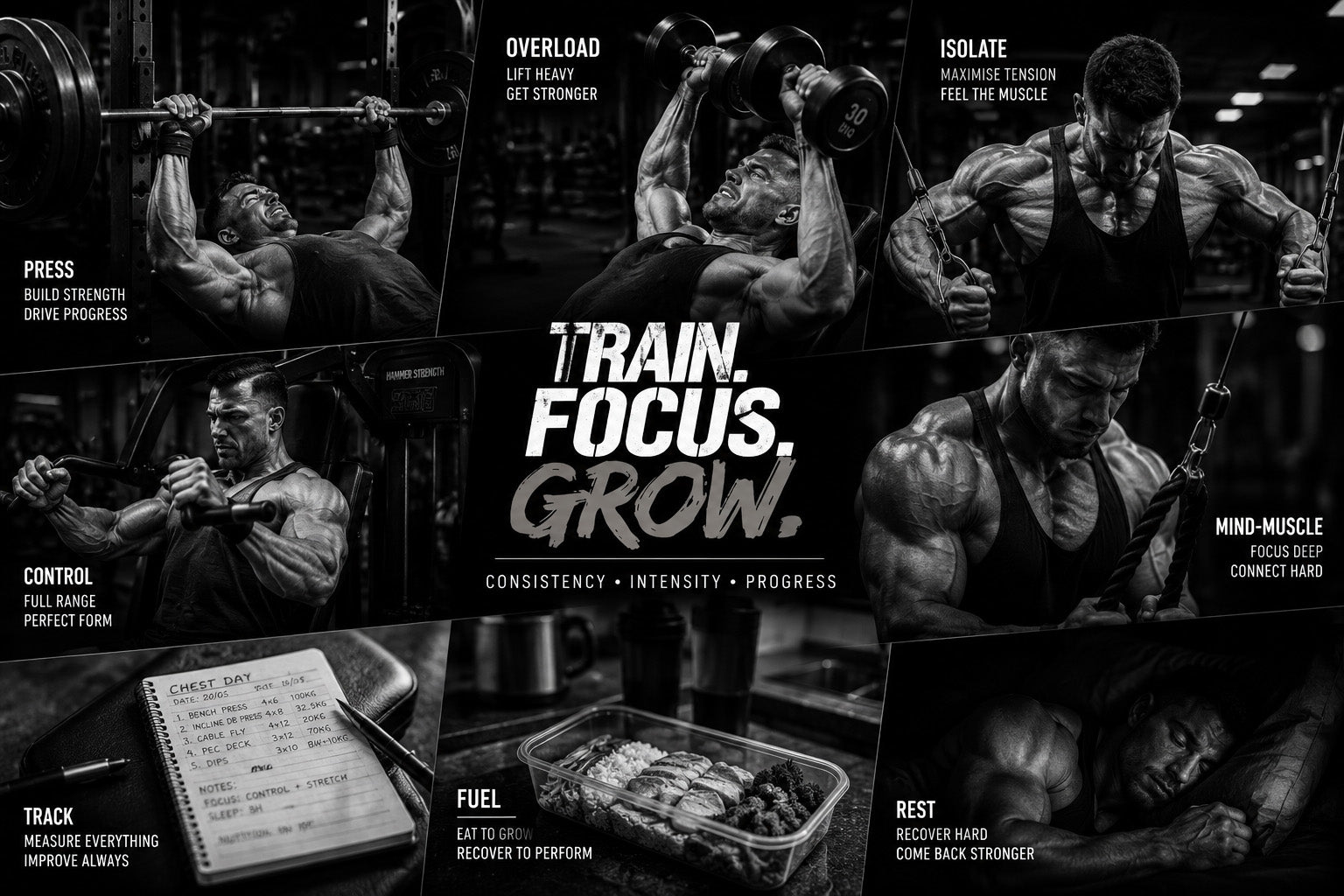
Cables let you alter height, stance and arm path while maintaining external resistance through more of the movement. They are particularly useful for unilateral work and for training horizontal adduction without being locked to one fixed handle path.
- Set the cable height to match the desired line of pull.
- Use single handles to let each arm find a comfortable path.
- Step forward only far enough to maintain stability and cable clearance.
- Control the stretched position without letting the shoulder roll forward under load.
- Finish by bringing the upper arms across the torso, not merely touching the handles together.

Training solution
GymPin Long Ropes | Tricep ERGO Handles
Explain exactly which training or equipment limitation this product solves.
Train the chest, respect the joint
Shoulder-friendly chest training is individual
There is no universally perfect grip, elbow angle or bench position. Select ranges and exercises that load the chest without sharp or worsening pain, and modify the setup before simply adding more weight.
- Choose a tolerable angle.Flat, incline, converging and cable presses all create different demands. No single angle is mandatory.
- Let the upper arm move naturally.A moderate elbow angle is often comfortable, but anatomy and equipment differ.
- Use the scapula appropriately.A stable bench press setup differs from a push-up or cable fly, where scapular movement can be useful.
- Modify pain, do not negotiate with it.Reduce load or range, change the exercise and seek qualified assessment for persistent or worsening pain.
Training solution
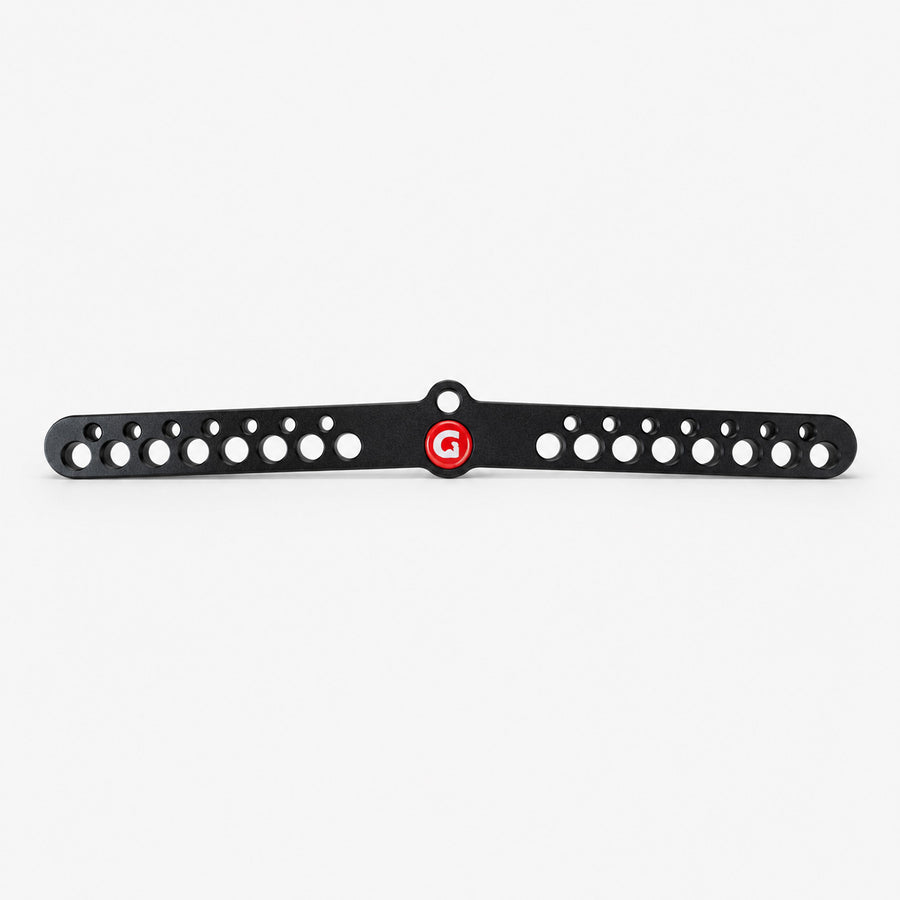
D Handle Bar by GymPin
Explain exactly which training or equipment limitation this product solves.
Independent social proof
What customers say
See how lifters use GymPin products across real cable, machine and home-gym setups.
Solve the real limitation
When the setup becomes the limiting factor
Equipment should enter the conversation only when it improves loading, fit, stability, movement freedom or progression. These recommendations are organised by the problem they solve.
The cable stack is too light
A compatible GymPin loading solution can extend a selectorised stack with Olympic plates. Pin diameter, clearance, machine condition and manufacturer limits still apply.
The machine path feels better than free weights
Stable chest presses can provide excellent hypertrophy work. Progress the machine rather than abandoning a productive movement merely because the standard stack ends.
The fixed handle irritates the wrist or shoulder
Independent cable handles can allow a more individual arm path and grip orientation on compatible cable exercises.
Jammer arms need a better pressing setup
Compatible adapters and handles can improve positioning, convergence and exercise choice on supported systems. Exact rack and hardware compatibility is essential.
Training solution
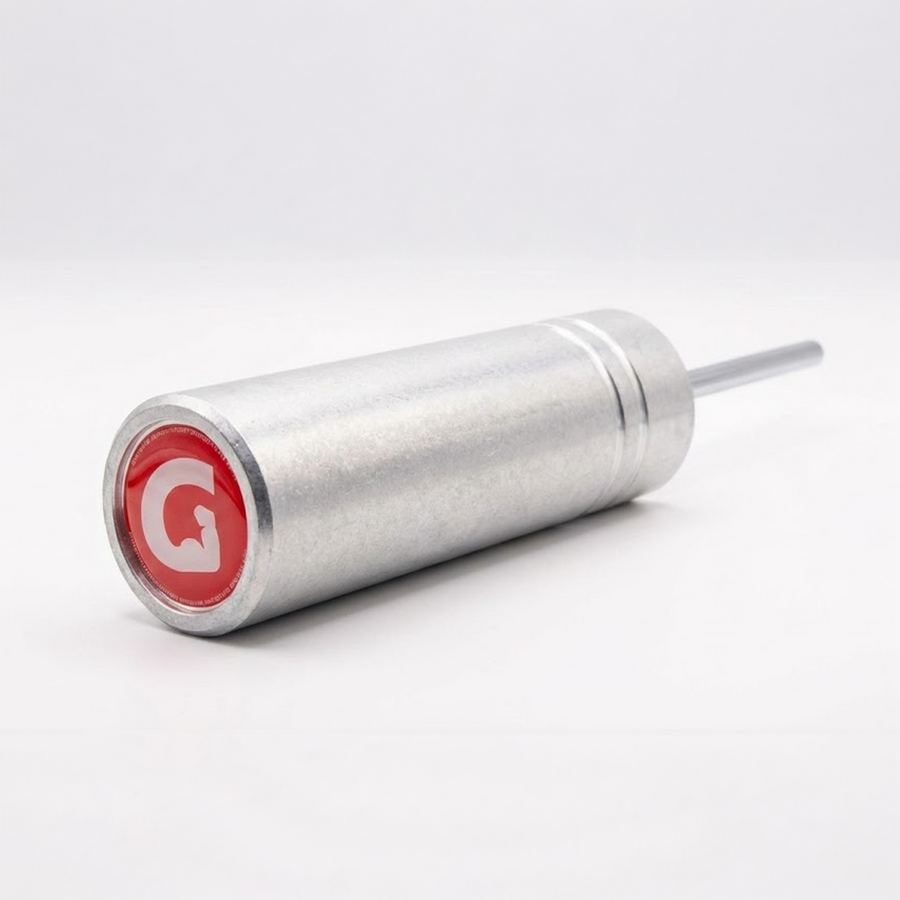
The Original 2" GymPin Cable Stack Extender
Explain exactly which training or equipment limitation this product solves.
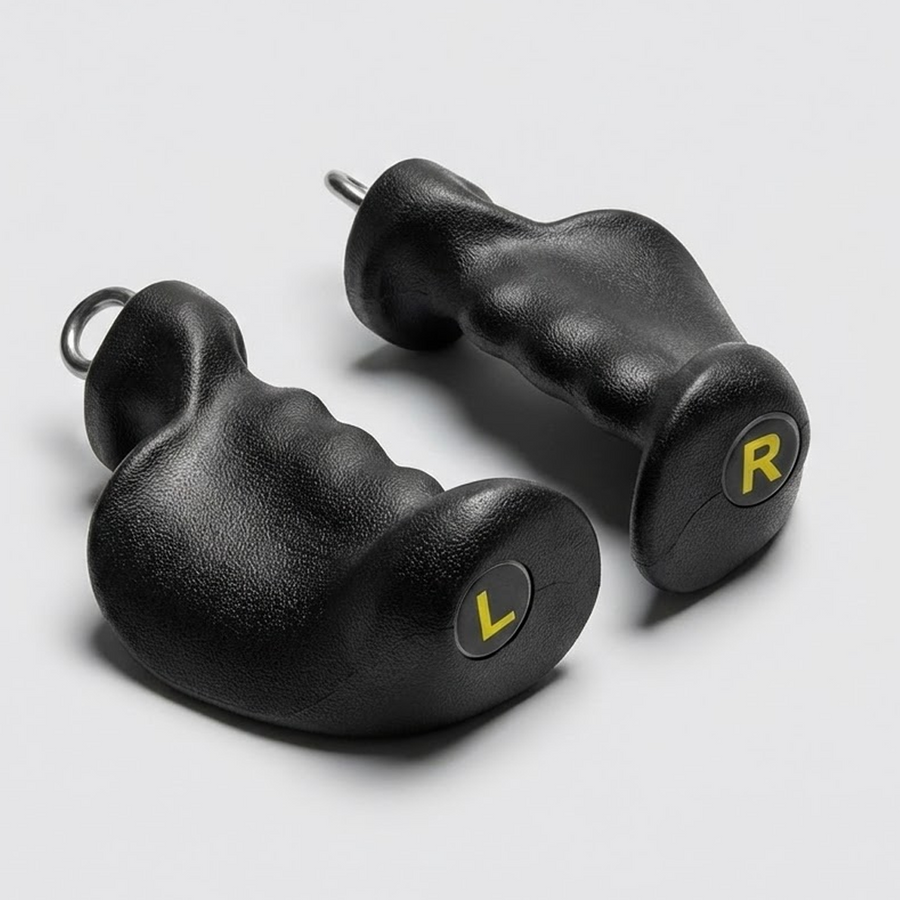
Training solution
GymPin Ergo Handles (PAIR)
Explain exactly which training or equipment limitation this product solves.
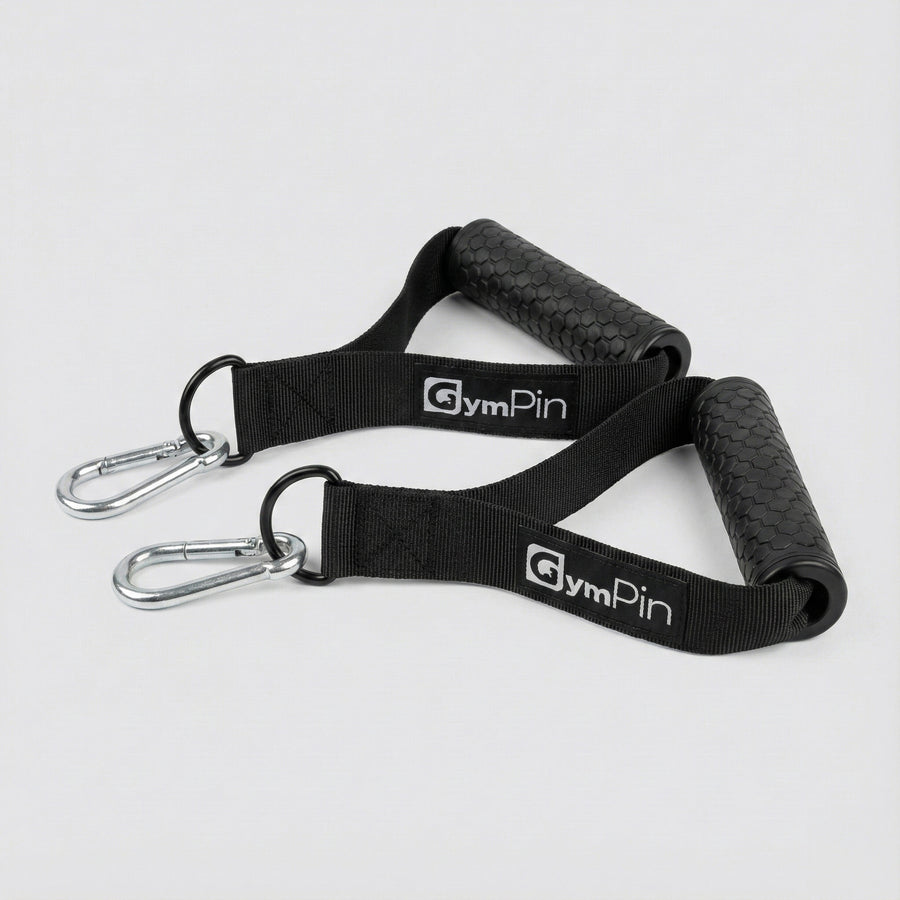
Training solution
Fabric D Handles
Explain exactly which training or equipment limitation this product solves.

Training solution
Super Long Looped Tricep Ropes
Explain exactly which training or equipment limitation this product solves.
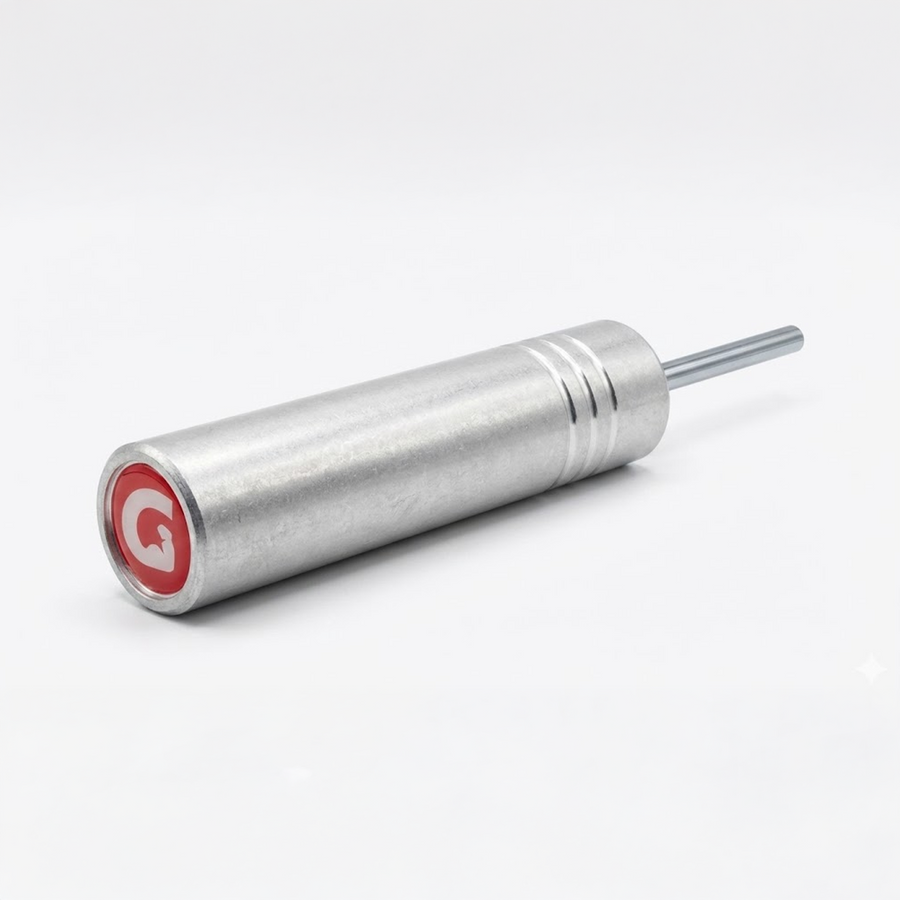
Training solution
KingPin 10mm Weight Stack Extender
Explain exactly which training or equipment limitation this product solves.

Training solution
The 2" MiniPin by GymPin
Explain exactly which training or equipment limitation this product solves.

Training solution
2" Olympic External Extenders
Explain exactly which training or equipment limitation this product solves.

Training solution
2" Olympic Machine Extenders
Explain exactly which training or equipment limitation this product solves.
Programming examples
Chest training templates
Use these as starting points, not commandments. Adjust exercise choice, set volume and frequency to training age, recovery and available equipment.
Beginner · twice weekly
Simple press and fly rotation
- Machine or dumbbell press — 3 × 6–10
- Cable or pec-deck fly — 2 × 10–15
- Push-up — 2 controlled sets
Repeat later in the week with a modest incline press and a different fly angle.
Intermediate · twice weekly
Flat and incline emphasis
- Day 1: flat press 3–4 sets; cable fly 3 sets
- Day 2: incline press 3–4 sets; machine press 2–3 sets; fly 2 sets
Keep most sets around 1–3 repetitions in reserve, taking selected isolation sets closer to failure.
Advanced · 2–3 sessions
Distributed specialisation
- Heavy press exposure
- Clavicular-biased press and cable work
- Machine and fly volume session
Use specialisation blocks sparingly and reduce competing upper-body volume if recovery begins to erode.
The supporting system
Chest growth still depends on the boring fundamentals
ProteinConsume enough daily protein and distribute it across meals using foods you can sustain.
Energy intakeAggressive dieting can restrict training performance and muscle gain. Match calories to the current goal.
SleepConsistent sleep supports performance, recovery and adherence.
Back and cuff trainingRows, rear-delt work and appropriate rotator-cuff training support balanced shoulder function.
Technique recordsUse a training log and occasional video to judge whether progression is real or merely shorter range and more momentum.
PatienceVisible hypertrophy requires months of repeatable work. The chest has not read your launch schedule.
Frequently asked questions
Chest training questions, answered
Practical answers on exercise choice, frequency, volume, cables, machines and shoulder comfort.
How often should I train chest?
Most people will see the best results training their chest twice per week. Splitting your weekly training volume across two sessions allows you to perform more quality repetitions, recover more effectively and practise key movements more often. Aim for around 10 to 20 challenging sets per week, adjusting volume based on your training experience and ability to recover.
What are the best exercises to build a bigger chest?
The most effective chest workouts combine compound presses with isolation exercises.
A balanced session should include:
- Barbell or machine chest press for overall strength
- Incline pressing to bias the upper chest
- Cable flyes for continuous tension
- Pec deck or machine flyes for controlled isolation
- Weighted dips where appropriate
Rather than searching for one "perfect" exercise, focus on movements that allow a full range of motion, good control and consistent progression over time.
Are cables better than dumbbells for chest training?
Neither is universally better. Both have advantages.
Dumbbells challenge stability and allow a natural pressing path, while cable machines provide resistance throughout almost the entire movement and make it easier to keep tension on the chest.
Cable exercises are particularly useful for flyes, unilateral training and higher-repetition hypertrophy work. When the selectorised stack becomes too light, products like the Original GymPin allow you to continue progressing without changing machines.
Why don't I feel my chest working during presses?
If your shoulders or triceps fatigue before your chest, technique is usually the problem rather than muscle activation.
Common causes include:
Elbows tucked too tightly
Pressing with the shoulders instead of driving the upper arms together
Limited range of motion
Using more weight than you can control
Rushing each repetition
Reduce the load, slow the lowering phase and concentrate on bringing your upper arms across your body rather than simply pushing the handles away.
Can machines build as much chest muscle as free weights?
Yes. Research shows that machines, cables and free weights can all build significant muscle when exercises are performed with sufficient effort and progressive overload.
Machines often provide greater stability, allowing you to focus on the target muscle without balancing the load. Free weights challenge stabilising muscles and offer greater exercise variety. The best programmes usually include both.
How many chest exercises should I do in one workout?
For most people, three to five exercises is plenty.
A well-balanced session could include:
One heavy horizontal press
One incline press
One cable or pec deck fly
An optional machine press or dip variation
Adding more exercises rarely produces better results if training quality begins to drop.
Should I train chest to failure?
Training close to failure is effective, but every set doesn't need to end with the weight pinned to your chest.
For most exercises, finishing with one to three repetitions in reserve provides an excellent balance between muscle growth and recovery. Isolation exercises like cable flyes can usually be taken closer to failure than heavy compound presses, where fatigue and technique breakdown increase more quickly.
How do I progressively overload chest exercises?
Progressive overload means gradually asking your muscles to do more work over time.
You can achieve this by:
Increasing resistance
Performing more repetitions
Improving technique
Controlling the movement more effectively
Increasing your range of motion
Adding an extra set when appropriate
Eventually, many lifters find that their strength outgrows the selectorised weight stack rather than the exercise itself. When that happens, the Original GymPin allows you to add more resistance and continue progressing without changing your favourite cable machine.
Train the muscle. Improve the setup.
BUILD A BIGGER CHEST. KEEP PROGRESS MOVING.
Choose productive movements, progress them patiently and use equipment only when it solves a genuine limitation.