


GYMPIN TRAINING HUB
Build a Bigger Back
Build wider lats, a thicker upper back and a stronger posterior chain with evidence-informed exercise selection, progressive overload and equipment that solves real training limits.
- Six productive movement choices
- Width, thickness and posterior-chain work
- Joint-aware setup and progression
Quick answer
How do you build a bigger back?
Build a bigger back by training more than one pulling pattern. Combine a vertical pull for the lats, a stable row for the upper back, a row that lets the elbow travel towards the hip, a straight-arm pull and controlled work for the spinal erectors. Perform enough challenging weekly sets, work close to muscular failure without sacrificing position, and progress repetitions, load or usable range over time.
What is holding your back training back?
Choose an individual upgrade for your next session, or explore the complete back-training bundle.
Stack too light?
Add plate resistance to a compatible machine. Check your pin size and the machine limits first.
Choose your GymPin£54.95
Need a better pulling setup?
Explore hand-spacing options for cable rows and pulldowns.
Explore D Handle Bars£49.95
Grip gives out first?
Support demanding rows and pulldowns when your hands become the limiting factor.
Explore lifting straps£21.95
Building a complete setup?
Explore the nine-product bundle and check the equipment compatibility for each item.
View the full bundle£581.59
Problem solving
Why back growth stalls
Most plateaus come from missing movement patterns, poor stability, grip or arm fatigue, unproductive momentum, or a machine that genuinely no longer provides enough resistance.
Every exercise becomes an arm exercise
The biceps will assist pulling. Reduce the load, secure the torso and think about moving the elbow rather than curling the attachment.
You only train one direction
Rows do not fully replace vertical pulls, and pulldowns do not provide all the upper-back and erector work a complete programme needs.
Momentum changes every repetition
A small amount of body movement can be intentional, but a different torso angle on every rep makes progression difficult to judge.
Your grip gives out first
Grip deserves training, but it does not need to cap every hypertrophy set. A secure handle or straps can keep the intended back muscles as the limiting factor.
You mistake width for lat recruitment
An extremely wide pulldown grip shortens the movement and does not automatically train the lats better. Choose the grip that gives you control and useful range.
Your resistance has stopped progressing
Improve execution and rep quality first. If a compatible stack or loading point is still the limit, solve that equipment problem deliberately.
Anatomy made useful
Train the back you can see — and the structure beneath it
The back is a system of muscles with different lines of pull. Exercise angle changes emphasis, but no cable setting or grip completely isolates one region.
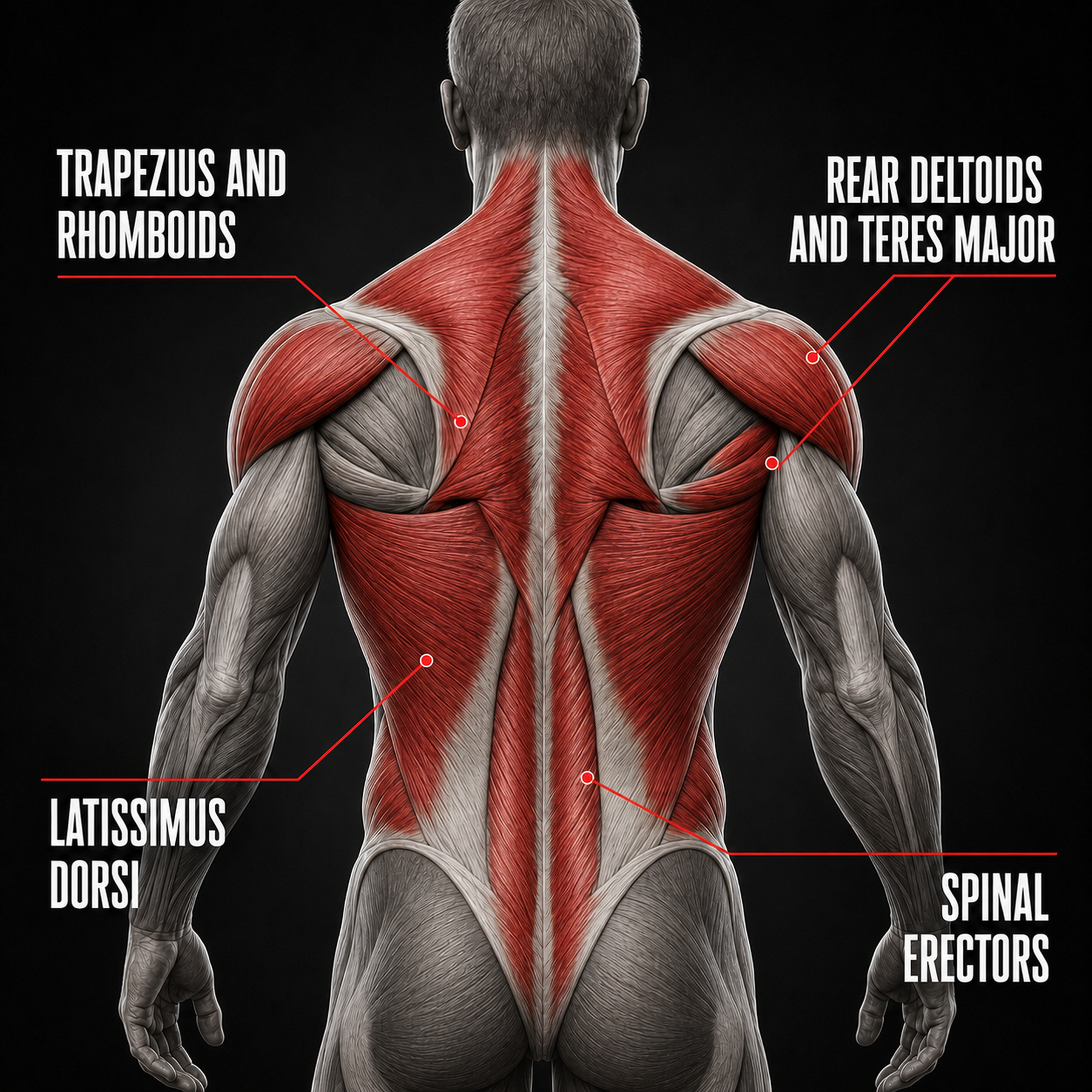
Latissimus dorsi
The lats extend and adduct the upper arm. Pulldowns, pullovers and rows where the elbow travels towards the hip are productive choices.
Useful intent Reach under control, keep the ribs organised and drive the upper arm down or back.Trapezius and rhomboids
These muscles control and reposition the shoulder blades. Rows with a wider elbow path, supported high rows and reverse flyes can load them effectively.
Useful intent Move the shoulder blade without turning the finish into a neck-dominant shrug.Rear deltoids and teres major
The rear delts contribute to horizontal abduction and shoulder extension. Teres major assists many lat-dominant pulling actions.
Useful intent Use a wider elbow path for rear-delt emphasis and a closer path for more lat contribution.Spinal erectors
The erectors resist spinal flexion and extend the trunk. Back extensions, Romanian deadlifts and unsupported rows can all challenge them.
Useful intent Brace and hinge at the hips; do not manufacture range by repeatedly collapsing through the lower back.The growth method
Use the variables that matter
The newest evidence still points back to a few fundamentals: sufficient weekly work, challenging sets, progressive resistance and a range you can control. Complexity is optional.
Weekly volume
Around ten or more challenging weekly sets can be a useful hypertrophy benchmark, but the back contains several regions. Distribute work across lats, upper back and erectors rather than assigning every set to one imaginary muscle.
Effort
Most working sets should end close enough to failure to be meaningfully hard. Roughly one to three good repetitions in reserve is practical for many sets; reaching absolute failure is not required every time.
Frequency
Training the back twice weekly often makes quality volume easier to recover from and gives you two chances to practise the key movement patterns.
Range and length
Use a controlled reach where the target muscle is lengthened, but do not chase an extreme stretch by losing shoulder or spinal position. More range only helps when it remains usable.
Progression
Keep the setup stable, add repetitions within a target range, then add a small amount of load. Range, control and reduced assistance can also be genuine progression.
Exercise stability
Stable exercises are not less functional. Chest support, secure handles and consistent machine settings can make it easier to apply high effort to the intended muscles.
Six proven, achievable choices
The back exercise library
These six movements cover the major jobs without relying on specialist strength or circus-level setup.
01
Lats · vertical pull
Lat pulldown
An accessible vertical pull that is easy to scale, stabilise and progress across a wide range of strength levels.
- Set up
- Secure the thighs, choose a comfortable grip around shoulder width or slightly wider and sit with the ribs controlled.
- Perform it
- Reach overhead under control, then drive the elbows down towards the ribs. Finish without turning the movement into a reclining row.
- Working range
- 3–4 sets of 6–15 reps
- Progress it
- Add repetitions within the target range, then increase the stack by the smallest useful amount while preserving the same torso angle.
- Avoid
- Pulling behind the neck, choosing an unnecessarily wide grip or leaning farther back as fatigue rises.
Choose hand spacing that suits your pulldown setup.
Explore D Handle Bars
02
Upper back · stable row
Chest-supported row
Chest support removes much of the demand on the spinal erectors and makes it easier to train the upper back hard with repeatable technique.
- Set up
- Set the pad so the chest is supported without compressing your breathing. Choose handles that let the wrists and elbows follow the intended path.
- Perform it
- Begin with a controlled reach. Row the elbows back, pause briefly without lifting the chest from the pad and lower through the same path.
- Working range
- 3–4 sets of 8–15 reps
- Progress it
- First make the pause and eccentric consistent. Add repetitions, then load, without shortening the reach.
- Avoid
- Lifting the torso from the support, shrugging every rep or using a handle that forces an uncomfortable wrist position.
Support your grip when your hands limit a supported row.
Explore lifting straps
03
Lats · unilateral control
One-arm cable row
Independent cable work lets each shoulder blade and upper arm move naturally while making side-to-side differences easy to identify.
- Set up
- Use a stable split or seated stance, set the cable around lower-rib height and start with the working arm reaching forwards under control.
- Perform it
- Keep the torso quiet and drive the elbow back and slightly down towards the hip. Allow a controlled reach before the next repetition.
- Working range
- 3 sets of 8–15 reps per side
- Progress it
- Match repetitions between sides, then add load only when the weaker side reaches the top of the range cleanly.
- Avoid
- Rotating the entire torso, curling the handle or pulling the elbow far behind the body to create false range.
04
Lats and upper back · heavy row
Single-arm landmine row
A stable handle and arcing bar path create a productive heavy row without requiring the hand to grip the bare end of the bar.
- Set up
- Secure the bar in a landmine or stable corner, fit a purpose-made row handle and hinge into a strong, repeatable torso position.
- Perform it
- Brace, let the shoulder reach and row the elbow towards the hip or lower ribs. Lower the plates without losing the hinge position.
- Working range
- 3–4 sets of 6–12 reps per side
- Progress it
- Add small plates or repetitions while keeping the same torso angle, start point and pause at the top.
- Avoid
- Standing more upright on every rep, twisting hard through the torso or using a direct bar grip that feels unstable.
Use a purpose-made handle with your compatible landmine setup.
Explore the Row Handle
05
Lats · shoulder extension
Straight-arm cable pulldown
This trains shoulder extension with much less elbow flexion than a row or pulldown, making it useful when the biceps dominate other pulls.
- Set up
- Set the cable high, step back far enough to reach overhead and keep a soft but nearly fixed elbow. A long rope allows the hands to separate.
- Perform it
- Keep the ribs stacked and sweep the upper arms down towards the sides. Return slowly until the lats reach a controlled stretch.
- Working range
- 2–4 sets of 10–20 reps
- Progress it
- Increase repetitions and range before load. The movement should remain an upper-arm sweep, not become a triceps pressdown.
- Avoid
- Bending the elbows repeatedly, arching the lower back or using momentum to force the rope behind the body.
A longer rope lets your hands separate through the pull.
Explore the Long Rope
06
Erectors and posterior chain
45-degree back extension
A scalable way to train the spinal erectors, glutes and hamstrings with less setup complexity than a heavy barbell hinge.
- Set up
- Position the pad below the hip crease so the hips can move. Brace the trunk and begin with bodyweight or a securely held load.
- Perform it
- Hinge forwards at the hips under control, then extend until the body forms a straight line. Keep the head and ribs organised.
- Working range
- 2–4 sets of 8–20 reps
- Progress it
- Own the full bodyweight range first, then add reps, tempo or centred external load using a compatible setup such as the Hyper Loader.
- Avoid
- Hyperextending at the top, bouncing from the bottom or forcing depth by rounding repeatedly through the lower back.
Add centred plate loading to a compatible 40–45° bench.
Explore the Hyper LoaderCable training
Let the attachment serve the movement
Cable resistance is valuable because the direction of pull, handle and body position are easy to adjust. That flexibility is wasted when every exercise is forced through the same fixed bar.
D Handle Bar
Change hand spacing and pulling angle across pulldowns, seated rows and unilateral variations without replacing the whole station.
Barbell Row Handle
A secure, purpose-built grip for single-arm landmine rows and heavy barbell-row variations.
Long Rope
Useful for straight-arm pulldowns, face pulls and movements where a standard short rope restricts separation or range.
Original GymPin
When a compatible selectorised row or pulldown stack is genuinely too light, external plate loading can restore measurable progression.

Train the back. Respect the joints.
Make hard pulling sustainable
The target muscles should work hard. Sharp pain, instability, radiating symptoms or a worsening joint problem are not useful evidence that a set is productive.
Let the shoulder blade move
Controlled protraction and upward movement at the stretched position are normal in many rows and pulldowns. Do not force every repetition into a rigid “down and back” posture.
Choose a tolerable grip
Neutral and independently rotating handles often feel natural. A grip is not superior merely because it is wider, narrower or more difficult.
Manage elbow stress
Repeated heavy underhand pulling can irritate some elbows. Rotate grips, control the eccentric and reduce load before abandoning the movement pattern.
Respect spinal fatigue
Heavy hinges, unsupported rows and back extensions all tax the erectors. Spread them across the week instead of turning every back session into a lower-back endurance test.
Use straps with intent
Use them when grip ends a back-focused set too early. Keep separate unassisted work if improving grip strength is also a goal.
Modify pain, do not negotiate with it
Change the grip, range, load or exercise when discomfort persists. Seek assessment from an appropriately qualified professional for persistent or concerning symptoms.
Independent social proof
Built for lifters who keep progressing
Equipment that solves a real problem
Build the movement first. Then fix the limit.
Every product recommendation below has a specific job: improve the connection, create a better pulling path, support grip, extend loading or make posterior-chain progression easier.
Improve the pulling path
D Handle Bars and Long Ropes provide useful cable-angle choices, while the Barbell Row Handle adds a secure position for heavy landmine rows.
Progress the resistance
The Original GymPin adds Olympic plates to compatible selectorised machines. KingPin is the 10 mm-only heavy-duty option with a 60 kg load rating.
Stabilise heavy rows
The Barbell Row Handle provides a purpose-built 33 mm handle for secure single-arm landmine and heavy barbell-row variations.
Load the posterior chain
The Hyper Loader adds centred plate loading to a compatible 40–45° hyperextension bench, supporting deeper, progressive back-extension work.
Stop grip ending the set
Padded Leather Straps support heavy rows and pulldowns when the hands fail before the intended back muscles.
Make progress visible
The Training Logbook records the load, repetitions and setup that make progressive overload measurable rather than memorable.

Cable pulling
D Handle Bar by GymPin
Multiple useful pulling positions for lat pulldowns, seated rows and unilateral cable work.
View product
Starting position
Starting Blocks
GymPin Starting Blocks are compact high-density foam blocks designed to help lifters start machine-based exercises from a stronger, more comfortable position.
View product
Progressive load
Original 2" GymPin
Add Olympic plate resistance to compatible selectorised row and pulldown stacks.
View product
Heavy stack work
KingPin
The heavy-duty 10 mm-only option, rated to 60 kg. Load and lower the stack under control.
View product
Heavy rows
GymPin Barbell Row Handle
A secure, purpose-built grip for single-arm landmine rows and heavy barbell-row variations.
View product
Range of motion
GymPin Long Rope
More separation and usable range for straight-arm pulldowns, face pulls and cable work.
View product
Grip support
Padded Leather Lifting Straps
Double-ply padded leather support for back sets where grip is the premature limit.
View product
Posterior chain
Hyper Loader
Centred plate loading and deeper range for compatible 40–45° hyperextension benches.
View product
Track progress
GymPin Training Logbook
Record exercise setup, repetitions and load so each progression has a clear baseline.
View productProgramming examples
Turn the exercise list into a plan
These are starting templates, not mandatory routines. Keep the movements that fit your equipment and joints, then adjust weekly work according to performance and recovery.
Minimum effective structure
One focused back session
- Lat pulldown — 3 × 8–12
- Chest-supported row — 3 × 8–12
- Back extension — 3 × 10–15
Use when the rest of the week already contains pulling work. Add volume only when progress and recovery justify it.
Beginner · twice weekly
Full-back foundation
- A: pulldown 3 × 8–12
- A: chest-supported row 3 × 8–12
- A: back extension 2 × 10–15
- B: one-arm cable row 3 × 10–15
- B: pulldown 3 × 10–15
- B: reverse fly 2 × 12–20
Leave at least two days between sessions and keep roughly one to three good reps in reserve on most working sets.
Intermediate · two emphases
Width and thickness split
- A: pulldown 3 sets
- A: one-arm cable row 3 sets
- A: straight-arm pulldown 2 sets
- B: chest-supported row 4 sets
- B: landmine row 3 sets
- B: loaded back extension 3 sets
Add rear-delt or shrug work only when those regions need more direct attention and recovery remains strong.
Evidence and transparency
What this guide is built on
This page translates current resistance-training research into practical back training. Research on whole-body hypertrophy informs the loading, volume and effort guidance; exercise-specific evidence is interpreted cautiously because muscle activation does not prove long-term muscle growth.
- 2026 ACSM position stand on resistance-training prescription
- 2024 meta-regression on proximity to failure and hypertrophy
- 2025 meta-analysis of training at longer muscle lengths
- Study of grip width during the lat pulldown
Last evidence review: 23 July 2026. Educational content only; it is not a diagnosis or individual medical advice.
Frequently asked questions
Back training questions, answered
How often should I train my back?
Two sessions per week are practical for many lifters because they distribute quality work and technique practice. One or three sessions can also work when total weekly volume and recovery are managed.
How many weekly sets should I do for back growth?
Around ten or more challenging weekly sets is a useful general benchmark for hypertrophy, but the back contains several regions. Count what each movement actually trains, begin with a recoverable amount and add sets only when progress has stalled and recovery is sound.
What are the best exercises for a wider back?
Lat pulldowns, pull-ups, single-arm pulldowns, straight-arm pulldowns and rows where the elbow travels towards the hip are productive options. Choose the movements you can perform through a controlled range and progressively overload.
What are the best exercises for back thickness?
Chest-supported rows, cable rows, landmine rows, machine high rows and barbell rows can all build thickness. A wider elbow path generally increases upper-back and rear-delt contribution, while a closer path tends to involve the lats more.
Are pull-ups better than lat pulldowns?
Neither is universally better. Pull-ups move the body through space and can be highly effective, while pulldowns are easier to scale, stabilise and progress in smaller increments. Use the option that matches your current strength and lets you train the target muscles consistently.
Does a wider pulldown grip build wider lats?
No. A very wide grip does not automatically increase lat recruitment and often reduces usable range of motion. Select a width and forearm position that feel strong, comfortable and repeatable.
Should I use lifting straps for back training?
Use straps when grip fails several repetitions before the intended back muscles. They are a tool, not a requirement. Keep some unassisted pulling or direct grip work if grip strength is also an important goal.
Why do I feel pulldowns and rows in my biceps?
The biceps assist every pulling movement, so some effort is normal. Reduce the load, secure the torso, avoid curling the handle and focus on moving the elbow through the intended path.
Can I build a big back using machines and cables only?
Yes. Pulldowns, cable or machine rows, pullovers, reverse flyes and back extensions can cover the main back functions when they are trained hard and progressed. Free weights are useful, but they are not compulsory for hypertrophy.
Do deadlifts build the whole back?
Deadlifts strongly train the spinal erectors, traps and many stabilising muscles, but they do not replace direct rows and vertical pulls for complete lat and upper-back development.
What should I do when the lat pulldown or row stack is too light?
First confirm that range, control and exercise setup are consistent. If the compatible selectorised machine is still genuinely limiting progression, a correctly sized external loading pin can add plate resistance. Match the selector-pin diameter, check clearance and respect the machine manufacturer’s limits.
Do back extensions build the lower back?
Yes. Back extensions train the spinal erectors as well as the glutes and hamstrings, depending on technique and setup. Progress bodyweight control first, then add load gradually without repeatedly hyperextending at the top.
Build the back. Solve the setup.
Choose the pull. Control the rep. Progress the resistance.
Use the guide to fix missing movement patterns first, then choose the GymPin solution that removes a genuine equipment or grip limitation.